The Evolution of Jacket Architecture: From Structural Shoulder Pads to Textronic Solder Pads in Blazers and Coats
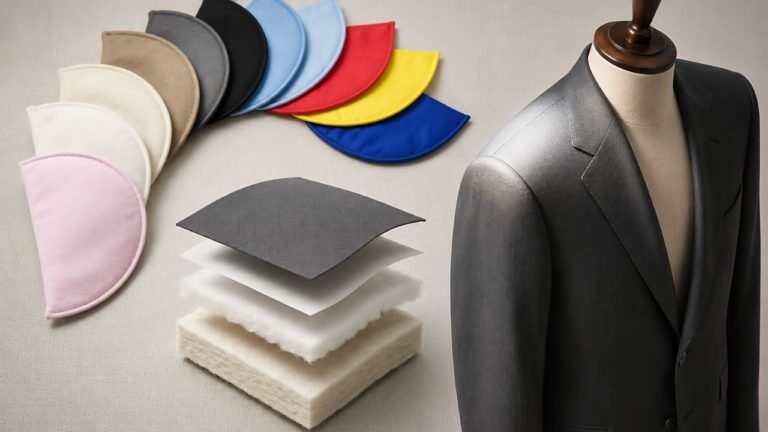
The structural integrity of tailored outerwear has historically relied on internal scaffolding to project authority, define silhouettes, and support the natural drape of heavy fabrics. In the classical tailoring tradition, this support was achieved through the “shoulder pad”—a physical insert composed of layered natural fibers designed to broaden the anatomical line of coats and blazers. However, as fashion intersects with digital technology, a profound evolutionary split has occurred. Modern “smart blazers” and wearable electronics now incorporate literal “solder pads”—electro-conductive metallic terminals printed or woven directly onto textile substrates to interface microelectronic sensors with conductive yarns.
While digital retail databases occasionally conflate these terms through typographical errors—such as cataloguing structured knit blazers as having “solder pads” rather than “shoulder pads”—the actual historical trajectory reveals a fascinating convergence. The engineering principles that once governed the modular insertion of structural shoulder pads in the mid-20th century now directly inform the integration of micro-sensors and solder-bonded conductive traces in 21st-century “textronic” apparel.
The Origin of the Blazer and Early Construction
The origins of the blazer as a distinct tailored garment date to the early and mid-19th century, emerging from two distinct British maritime and collegiate traditions. The first recorded use of the term is associated with the Lady Margaret Boat Club of St. John’s College, Cambridge, founded in 1825, whose members wore bright red, “blazing” flannel jackets. The second origin is traced to the HMS Blazer in 1837, when the ship’s captain ordered navy-blue double-breasted jackets with brass buttons for his crew to present a unified, highly structured appearance.
During this foundational era, there was no metal solder or electronic circuitry of any kind within these garments. Tailoring was entirely organic and mechanical, relying on a complex internal canvas to establish shape. The structural definition of early blazers was achieved using hand-worked, non-metallic techniques. Tailors used high-density diagonal hand stitches, known as pad stitching, to attach raw hair-canvas interlining directly to the wool under-collar and chest lapels, mechanically forcing the fabric to roll and hold a three-dimensional curve. Shape retention in the shoulder and chest regions was achieved through layers of stiffened linen, coarse horsehair canvas, and graduated wadding made of carded sheep’s wool or cotton batting. The garment was sculpted over custom tailors’ bucks using heavy, coal-fired irons, utilising moisture and heat to shrink or stretch the wool fibers into permanent anatomical forms without synthetic adhesives. Traditional tailoring thus achieved verticality and structural crispness purely through fiber tension and mechanical layering, completely isolated from the metallic metallurgy that would later define smart garments.
The Evolutionary Trajectory of Structural Shoulder Padding
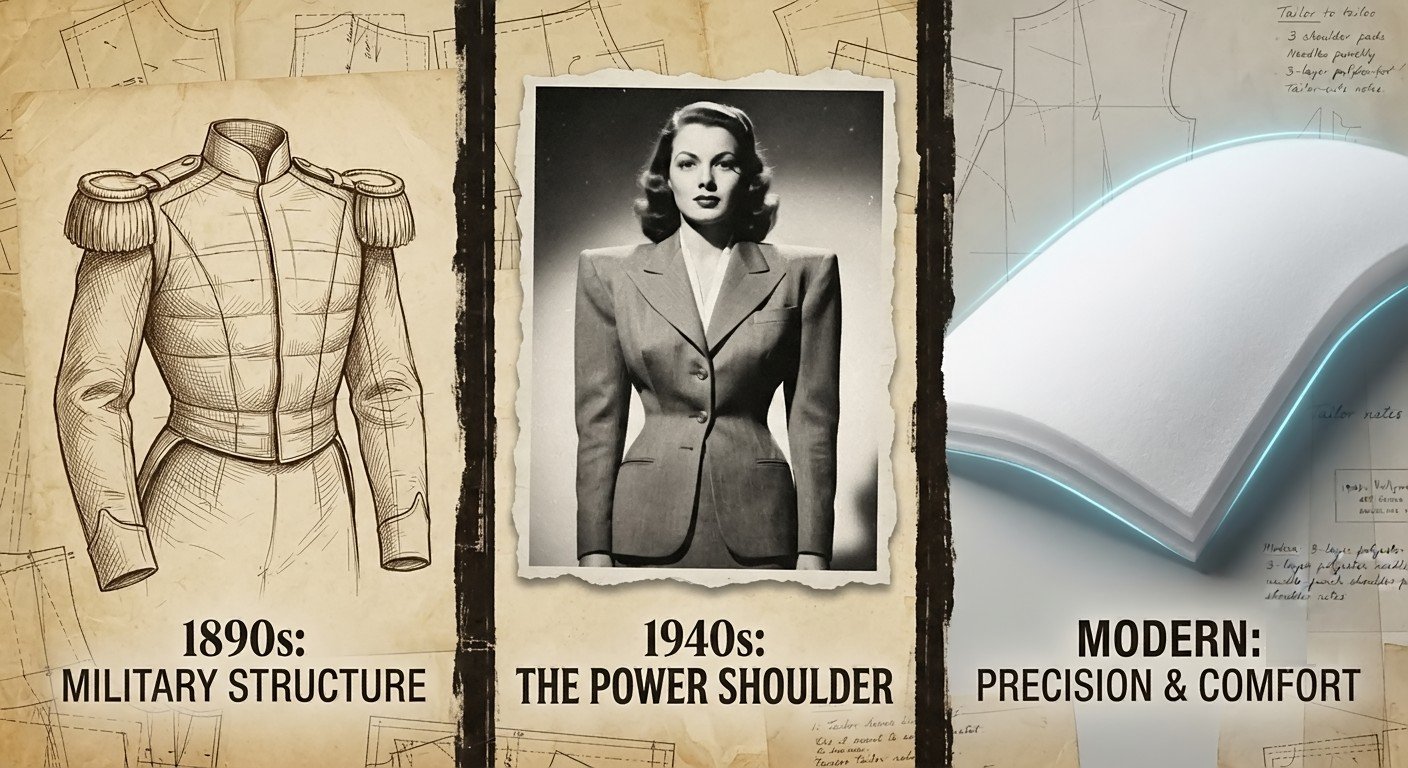
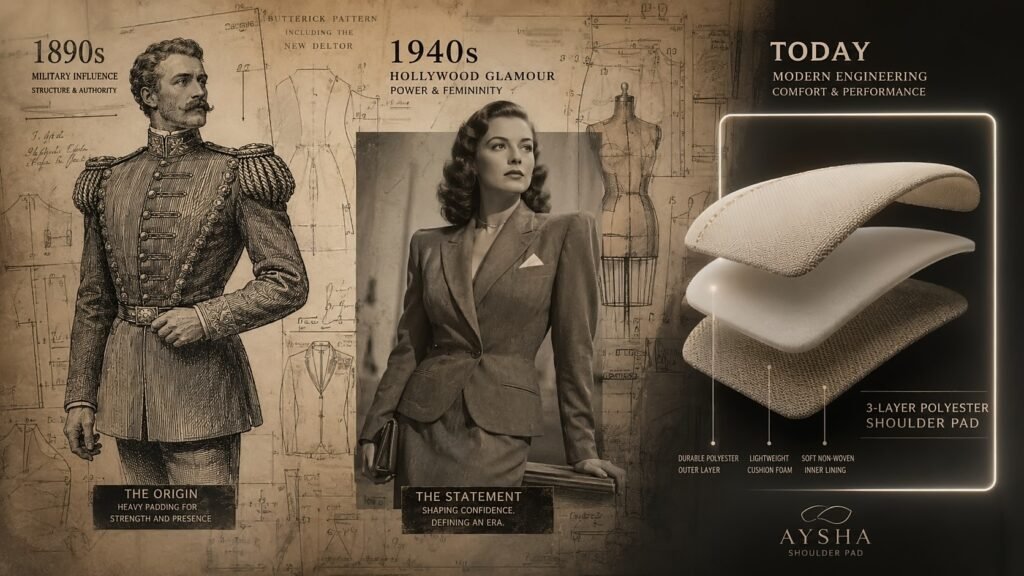
The deliberate exaggeration of the shoulder line to signal social status and physical power is deeply rooted in military and aristocratic history. In the 17th century, European court attire under Louis XIV featured padded doublets to broaden the upper body silhouette, establishing a visual hierarchy among the nobility. By the 18th century, structured padding became standardised in military uniforms, emphasising the chest and shoulders to project battlefield intimidation and officer authority.
The Athletic and Industrial Transition
The modern, standardised shoulder pad was born of practicality rather than aesthetics. In 1877, L.P. Smock, an athlete at Princeton University, invented protective shoulder pads for American football. These initial iterations consisted of leather and wool pads stuffed directly under the player’s jersey to absorb impact. By the early 20th century, these athletic devices underwent formal patenting and industrial design refinement. In 1906, Abraham Schemel patented a structured “Jacket for Football-Players,” which utilised rigid, moulded leather shoulder cups that moved independently of a flexible leather chest vest. Following the expiration of Schemel’s patent in 1921, the Spaulding Company began mass-producing this segmented design as the “Spaulding QS3,” cementing the transition of shoulder pads from custom-made athletic gear to mass-produced, standardised industrial components.
The Fashion Revolution and Elsa Schiaparelli
The migration of structured shoulder pads into civilian women’s fashion occurred in the early 1930s, spearheaded by the avant-garde couturières Elsa Schiaparelli and Marcel Rochas. Influenced by the surrealist movement and Southeast Asian ceremonial costumes, Schiaparelli introduced exaggerated, structured shoulders in her Autumn/Winter 1931–1932 “Wooden Soldiers” collection. By pairing wide, padded shoulders with a cinched waist, Schiaparelli created an optical illusion that made the wearer’s hips appear narrower, establishing a highly geometric, modern, feminine silhouette.
During the Great Depression and the subsequent onset of World War II, this aesthetic assumed deep political and socio-economic significance. Padded shoulders symbolised resilience and projected emotional and physical fortitude for women entering the labour market and public spaces. With the outbreak of war in 1939, civilian clothing became heavily militarised. Women’s “victory suits” featured boxy, square-edged shoulders constructed from layered cotton batting and stiffened felt, mirroring military uniforms and facilitating visual parity in male-dominated industrial environments.
Post-War Transitions and the 1980s Power Suit
In 1947, Christian Dior launched his revolutionary “New Look” (the Corolle collection), which explicitly rejected the boxy, combat-ready silhouette of the war era. Dior’s designs championed unpadded, sloping shoulders, soft bustlines, and expansive, un-rationed fabric skirts. The padded shoulder remained largely absent from mainstream women’s fashion until the late 1970s and 1980s, when the mass entry of women into corporate boardrooms catalysed the “power dressing” phenomenon. Designers such as Giorgio Armani, Claude Montana, and Thierry Mugler re-engineered the classic men ‘s-tailored blazer with highly exaggerated, foam-core shoulder pads. These oversized pads literally allowed women to take up more physical space in corporate environments, turning a structural garment component into an enduring political statement of professional equality.
The Rise of Industrial Shoulder Pad Manufacturing
In the immediate post-war era, the manufacturing of structural tailoring components underwent a crucial shift from bespoke, in-house atelier production to specialised, high-volume industrial factories.
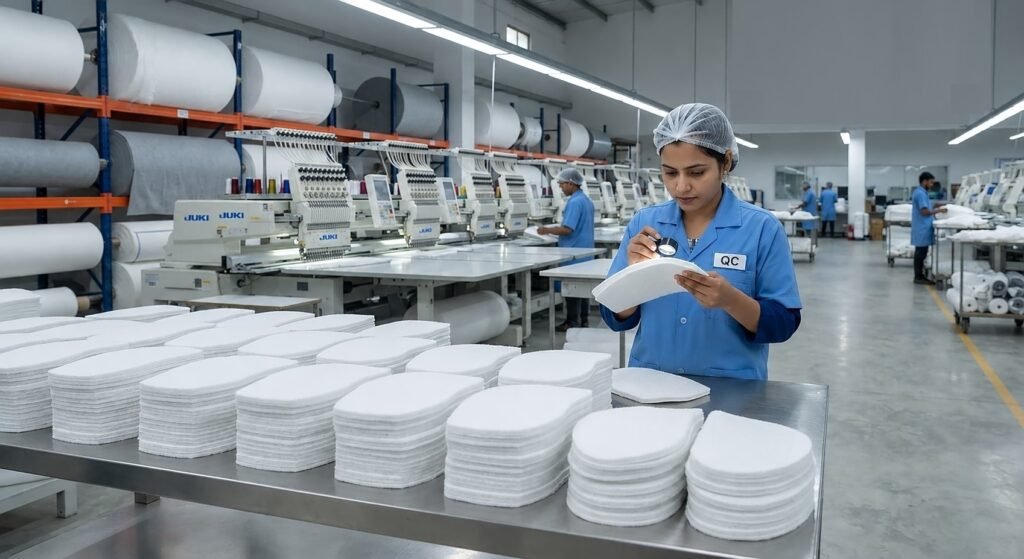
In 1947, Helmut Sandler founded the helsa® company in Gefrees, Germany, utilising his grandmother’s sewing machine to produce the first industrially manufactured, pre-formed shoulder pads. Prior to Sandler’s innovation, tailors and apparel factories had to construct each shoulder pad manually from loose cotton wadding and canvas, resulting in inconsistent sizing and significant labour costs. Sandler’s standardised, pre-fabricated shoulder pads—which he termed “invisible yet indispensable”—allowed garment factories to buy consistent, high-quality shaping parts in bulk.
Helsa rapidly expanded its technical expertise, introducing bonded facing silk in the 1970s and developing moulded synthetic materials in the 1980s. Today, helsa® Fashion Shaping operates globally across eight production sites, supplying customised “shaping packages” (including shoulder pads, sleeve head rolls, and interlinings) to international fashion brands.
Alongside Helsa, several European and American companies industrialised the internal architecture of the modern blazer. Freudenberg Performance Materials, established as a global leader in non-woven textiles, revolutionised garment assembly by developing advanced fusible interlinings. Using sophisticated heat-activated polyamide and polyester double-dot adhesive printing, Freudenberg enabled apparel manufacturers to fuse structuring elements directly to outer fabrics under heat and pressure, bypassing traditional hand-sewing.
Kufner Textile, renowned for producing high-quality chest canvases and hair-canvas inserts, combined natural wool yarns with resilient synthetic fibers to provide lightweight, highly elastic shape retention for luxury tailored menswear. Additionally, Hi Fashion Productions, based in Commerce, California, became the largest daily producer of shoulder pads in the United States. Utilising automated thermal-moulding machinery, the company achieved a daily capacity of over 60,000 moulded pads and 75,000 foam pads, supplying the high-volume ready-to-wear fashion market.
The Tech-Era Transition: Solder Pads and Wearable Tech in Blazers
At the turn of the 21st century, the field of “textronics”—the physical integration of microelectronics with textile and clothing structures—fundamentally redefined the blazer’s internal architecture. The modern blazer is no longer strictly a passive semiotic or anatomical device; it has increasingly become an active, interactive digital node. This transition replaced or augmented the traditional foam shoulder pad with flexible circuit boards, conductive silver-plated yarns, and literal “textile solder pads”.
The Mechanics of Textile Solder Pads
Integrating rigid microelectronic components onto flexible, heat-sensitive fabrics presents severe thermal and mechanical challenges. Traditional electronics manufacturing relies on soldering joints at temperatures exceeding 200 degrees centigrade. At these temperatures, synthetic garment fibers such as polyester, nylon, and spandex melt, while natural fibers such as wool and cotton scorch or degrade.
To overcome these barriers, textile engineers developed specialized materials and low-temperature metallurgical processes. Standard lead-free tin-silver-copper alloys are replaced with bismuth-tin alloys, most notably Sn42Bi58, which has a eutectic melting point of only 138 degrees centigrade. This allows electronic components to be reflowed onto textile-embedded conductors without compromising the underlying fabric’s structural integrity.
These contact points are manufactured using screen-printed conductive silver or carbon-based inks, or by weaving ultra-fine metal fibers directly into the fabric. These pads provide a stable, wettable metallic surface that allows solder to flow and form a secure mechanical and electrical bond with the terminals of micro-components.
To prevent solder joints from cracking due to the natural flexion and stretching of a blazer during wear, researchers utilize screen-printed or etched serpentine electrode geometries. These geometries distribute mechanical strain across the fabric, maintaining electrical continuity even under extreme deformation. Once soldered, the delicate junctions are hermetically sealed using liquid-state polymers. This creates a protective “micro-pod” around the solder pad, shielding the electrical connection from moisture, sweat, friction, and the mechanical stresses of laundering.
Commercialization: Google’s Project Jacquard and Beyond
The most prominent commercial application of this technology occurred in the mid-2010s through Google’s partnership with Levi’s on Project Jacquard. Rather than using external wires, Project Jacquard successfully synthesized conductive copper-core yarns directly into the denim sleeve of a commuter jacket. These conductive yarns are terminated in a touch-sensitive, interactive cuff containing miniature solder pad arrays. The cuff communicated with a small, detachable Bluetooth-enabled dongle, allowing urban cyclists to swipe or tap their sleeve to control navigation, answer phone calls, adjust volume, and play music without looking at their mobile devices. Furthermore, advanced smart jackets now incorporate silver-plated Shieldex conductive yarns linked to integrated temperature, respiration, and cardiac sensors, converting the classic tailored blazer into a wearable medical diagnostic platform.
Comparative Structural and Material Analysis
The structural evolution of the jacket represents a transition from high-loft mechanical cushioning to low-profile electrical interfaces. This technological divergence is illustrated in the structural and material timelines below.
| Development Epoch | Technology Type | Primary Materials | Assembly Method | Key Global Pioneers |
| 1825–1837 | Traditional Blazer Construction | Wool flannel, horsehair canvas, buckram linen, wool wadding. | Manual hand sewing, blind stitching, heavy steam pressing. | British collegiate tailors, Royal Navy outfitter yards. |
| 1877–1921 | Athletic Protective Padding | Heavily padded leather, carded wool wadding, canvas. | Manual stuffing under jerseys, later machine-sewn exterior shells. | L.P. Smock, Walter Camp, Abraham Schemel, Spaulding. |
| 1931–1945 | Structural Fashion Padding | Layered cotton batting, stiffened felt, buckram. | Hand-sewn set-in shaping, loose temporary tacking for laundering. | Elsa Schiaparelli, Marcel Rochas, Travis Banton, Adrian. |
| 1947–1989 | Industrialized Shaping Components | Polyurethane foam, needle-punched polyester, fusible adhesive webs. | Automated compression molding, machine needle-punching, fusing. | helsa® (Helmut Sandler), Freudenberg, Kufner, Hi Fashion Productions. |
| 2000–Present | Textronic Solder Terminals | Sn42Bi58 alloy, silver conductive inks, stainless steel micro-yarns | Low-temperature reflow soldering, PDMS polymer encapsulation. | Google (Project Jacquard), Statex (Shieldex), academic research consortia. |
Technical and Philosophical Confluences in Outerwear Scaffolding
A deep connection exists between the structural modularity pioneered by Helmut Sandler’s mass-produced shoulder pads in 1947 and the electronic modularity of 21st-century smart jackets. In 1940, designer Claire McCardell anticipated modern garment versatility by loosely stitching shoulder pads into garments so consumers could easily detach them, bypassing the need to wash and alter fashion silhouettes at will. This exact methodology is mirrored in Google’s Project Jacquard. Because microchips and lithium-ion batteries cannot withstand the high temperatures and chemical conditions of standard laundry cycles, modern textronic blazers rely on detachable electronic modules. The Bluetooth transmitter is housed in a rigid, removable cuff clip, while the passive conductive yarn and insulated solder pads remain embedded in the washable fabric. This demonstrates that the survival of advanced wearable technology relies on the same modular separation of structural shell and internal accessory first developed in mid-20th-century tailoring.
The transition of the blazer from a purely physical, structured garment (made of foam and canvas) to an active, digital interface (with solder pads and sensors) represents a fundamental philosophical shift in the function of clothing. Historically, the padded shoulder was a socio-political tool used to manipulate the body’s silhouette to project power, establish visual dominance, and claim physical space in male-dominated corporate or military hierarchies. In the digital era, the smart blazer derives power not from physical mass but from data connectivity. By embedding biometrics, NFC payment systems, and wireless controls directly into the lapels and cuffs, the garment becomes a seamless extension of the wearer’s digital identity. The blazer no longer projects power by visually exaggerating the human frame; instead, it empowers the wearer by transforming their immediate physical movements into digital commands, translating the classical rules of tailoring into the language of human-computer interaction.